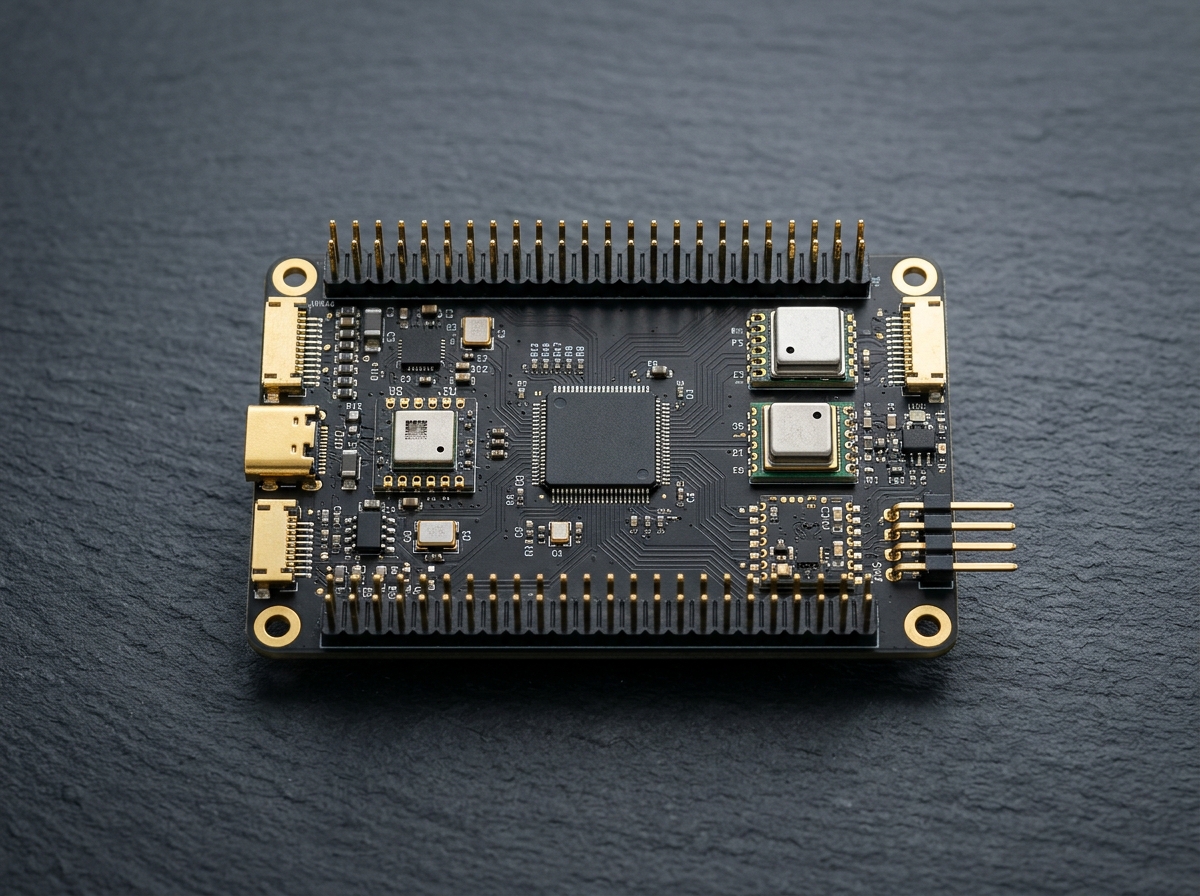
Brushless DC (BLDC) Motor Control Engineering: Three-Phase Inverters, Back-EMF & Field-Oriented Control (FOC)
Comprehensive engineering guide to brushless DC motors, 3-phase H-bridge inverter switching, Hall effect sensor commutation, sensorless zero-crossing back-EMF detection, and Field-Oriented Control (FOC) vector mathematics.

Brushless DC (BLDC) Motor Control Engineering: Three-Phase Inverters, Back-EMF & Field-Oriented Control (FOC)
Brushless DC (BLDC) and Permanent Magnet Synchronous Motors (PMSM) have superseded brushed motors in drones, electric vehicles, industrial robots, and precision CNC actuators due to superior torque-to-weight ratio, higher speed capabilities, and zero mechanical brush wear.
1. Motor Architecture & Six-Step Trapezoidal Commutation
A BLDC motor features permanent magnets on the rotating rotor and 3-phase electromagnetic windings (U, V, W) on the stationary stator. Electronic commutation is performed by a 3-phase inverter composed of 6 power MOSFETs (3 half-bridges).
In standard six-step commutation, at any given 60-degree electrical sector, two phases carry current (one driven high, one grounded) while the third phase floats, providing 6 distinct stator flux vectors that drag the rotor forward.
2. Sensorless Zero-Crossing Back-EMF Detection
In sensorless drives, three 120° Hall effect sensors are omitted. The un-energized third floating phase generates a trapezoidal back-EMF voltage. By filtering and monitoring when this voltage crosses the virtual motor neutral point (V_dc / 2), the microcontroller detects rotor zero-crossing and advances commutation by exactly 30 electrical degrees.
3. Field-Oriented Control (FOC) & Space Vector PWM
While six-step commutation creates noticeable torque ripple, Field-Oriented Control (FOC) vector control treats the 3-phase AC stator currents as a decoupled 2-axis DC system (d-axis for field flux, q-axis for torque):
Clarke Transform: Converts 3-phase stationary coordinates (Ia, Ib, Ic) into 2-phase stationary orthogonal coordinates (I_alpha, I_beta).
Park Transform: Rotates (I_alpha, I_beta) using rotor angle theta into rotating coordinates (Id, Iq) aligned with rotor flux.
Technical Discussion (0)
Sign in with your EIHOUSE INDIA account to join the technical discussion.
Sign In to CommentNo comments yet. Be the first engineer to contribute to this discussion.